
Room: Poster Area
Date: Tuesday, 19 May 2026
Time: 17:30 - 18:30 CEST
Session code 3AV.6
Biomass integration
Development and Validation of a MILP Framework for Optimal Design and Scheduling of Biogas-based Integrated Energy Systems
Short Introductive summary
Many innovative processes have been proposed for more profitable production/exploitation of biogas, but their optimal system integration is an open challenge. This work aims to develop a numerical optimization framework for technology selection, design and scheduling of biogas-based multi-vector integrated energy systems. Mixed-Integer Linear Programming (MILP) is applied to minimize total system costs within the constraints given by resource availability, connection with infrastructures, end-users demand, energy storage and energy conversion. The simulation framework was validated against a case study from literature consisting of an anaerobic digester, a photovoltaic field, a solar water heater, biogas storage, thermal energy storage, batteries and electrical, heat and gas demand of a residential household. Electrical, biogas and heat flows are aligned to reference results and the differences in costs and component sizes are within 4.4% of error, except for solar water heater (+21.9%), battery (not installed) and biogas storage (-68.0%). These differences can be attributed to different assumptions and capabilities of the two models.
Presenter
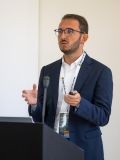
Dario COLOMBARI
Ricerca sul Sistema Energetico - RSE, Generation Technologies and Materials Dpt., ITALY
Presenter's biography
Researcher at Ricerca sul Sistema Energetico - RSE S.p.A. and PhD student at Politecnico di Milano. My research focuses on the optimisation of biogas energy systems and the integration of innovative processes. I am also interested in anaerobic digestion modelling and multi-physics simulations.dsfds
Biographies and Short introductive summaries are supplied directly by presenters and are published here unedited
Co-authors:
A. Rossetti, Ricerca sul Sistema Energetico - RSE, Milano, ITALY
M. Gatti, Politecnico di Milano, ITALY
Session reference: 3AV.6.3